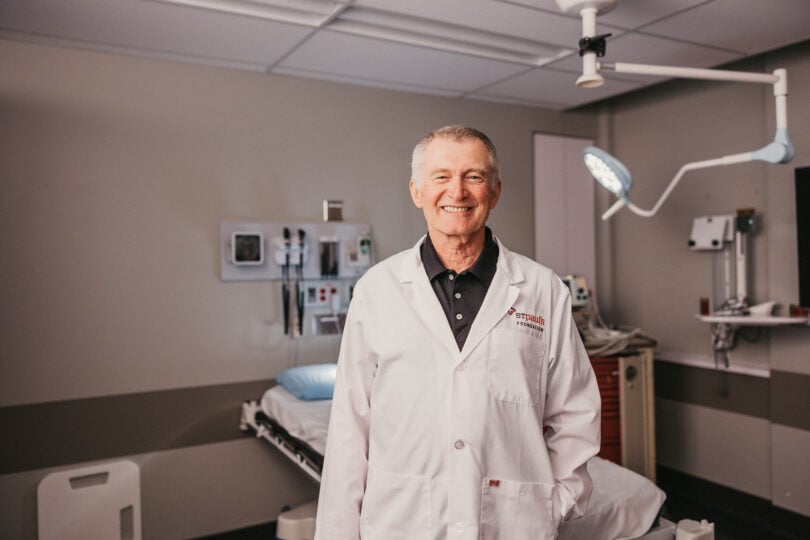
As an emergency physician at St. Paul’s Hospital and a scientist with the Centre for Advancing Health Outcomes, Dr. Jim Christenson helped shape emergency care at Providence Health Care and across British Columbia for nearly 50 years.
His work changed how chest pain patients are assessed, helped improve cardiac arrest survival, influenced paramedic practice, and strengthened emergency medicine research and education.
Now, that impact has earned him the Order of British Columbia (BC), the province’s highest honour. “I feel a ‘why me’ kind of thing… I do not think I am special,” he says.
Dr. Christenson is grateful for many things, in particular the support he continues to receive from his family, to which he attributes the success and longevity of his career. He did not set out in his work to earn accolades, but to save lives, reshape practice, and expand what emergency medicine can be.
“Anything that I’ve done, I never did it to get to this place… those things have their own rewards, their own satisfaction,” he explains. The Order of BC recognizes what he has accomplished with unwavering curiosity, patient-centred conviction, and a willingness to challenge assumptions and reshape the culture of health care.
“I just followed my nose, was curious, and tried to answer some questions,” says Dr. Christenson. That curiosity is what drove a consequential career in health care.
Rebuilding the foundations of emergency care
Emergency medicine was not always the specialty it is today. Across 46 years in the field, Dr. Christenson witnessed and helped drive its maturation from a transitional rotation for interns, often seen as a step towards the “real specialties,” into a cornerstone of modern health care.
Unlike other specialties, emergency medicine is where the entire health care system converges, from outpatient care and specialist services to general practitioners, to paramedics, ICUs, and community care providers.
“You have to be prepared to care for anybody that comes through the door… and that can be a patient who ultimately will need any one of many medical specialists,” says Dr. Christenson.
Emergency medicine is where the cracks in the health care system become visible, and where the consequences of those cracks are felt first. Dr. Christenson’s work strives to make these cracks impossible to ignore.
Transforming clinical practice through evidence and imagination
Dr. Christenson’s early research tackled problems that were both clinically urgent and systemically consequential. At a time when standard care required hospital admission for nearly all chest-pain patients, Dr. Christenson asked a deceptively simple question: Was this really necessary?
As Research Director for the Department of Emergency Medicine at St. Paul’s Hospital, this question informed his work on the ‘Vancouver decision rules’ for chest pain, a clinical tool used to identify the severity of chest pains and help reduce emergency department overcrowding, ultimately reshaping practice across B.C.
By studying symptoms, ECG findings, and pain characteristics, his team demonstrated that a significant number of patients could be safely discharged from the emergency department without admission.
“If they are not having a heart attack… they can go home,” he explains. This single insight freed up hospital beds, reduced unnecessary testing, and improved the patient experience, long before rapid diagnostics became standard.
He applied the same curiosity to the opioid crisis. Literature insisted heroin overdose patients required 24-hour admission, but the pharmacology did not make sense to him. So, he asked a simple question: why? He tested it, finding that “an hour after they are given naloxone…if their vital signs are normal… they are not going to collapse again.”
This changed practice, reduced strain on emergency departments, and, most importantly, respected the realities of patients’ lives for those who cannot afford to spend hours unnecessarily in hospital.
These insights emerged from listening, observing, questioning, and refusing to accept “the way things are” when patients deserved better.
Dr. Christenson has “always felt very rewarded by talking to somebody, getting their history, doing certain tests, making a diagnosis, and then treating them appropriately.”
Reimagining prehospital care
In the early stages of his career, Dr. Christenson recognized that not only was paramedic practice an underappreciated factor in patient care, but that emergency care begins long before a patient reaches the hospital.
“Emergency care is not just what happens in the emergency department, but what happens in the field with paramedics,” he says.
He found that there was a strong culture among paramedics to apply the same algorithm to every patient with chest pain, as opposed to asking what each specific patient needs. One of Dr. Christenson’s most influential contributions was shifting paramedic training away from rigid algorithms, toward patient-centred treatment guidelines.
He recalls a senior paramedic explaining how algorithmic thinking slowed care for patients in crisis. He gave an example: a patient collapses close to a hospital with classic heart attack symptoms. The algorithm says to start oxygen, place an IV, and administer medications, steps that could take up to 20 minutes. But what the patient truly needs is rapid cardiac catheterisation to unblock the artery. The best care in this circumstance is to minimize time in the field and move the patient quickly to the hospital for definitive care.
This shift in thinking from rote procedure toward real-time treatment guidelines improved outcomes for patients in emergency situations. This change in culture has empowered paramedics, accelerated care, and saved lives. For Dr. Christenson, it is one of his proudest accomplishments.
A system-level thinker in a system that resists change
Over time, Dr. Christenson’s curiosity expanded from individual clinical questions to the system itself. He saw inefficiencies everywhere: patients stuck in emergency departments because hospitals were full, waiting hours for care because triage systems were overwhelmed, or arriving in the emergency department because they lacked family doctors.
Emergency departments, he says, have become “the safety net for the whole health care system.”
He realized that improving emergency care requires improving the system around it. But systemic change is notoriously difficult.
“Moving the system is a very difficult thing to do,” he says. “Our system and leaders need to be more curious, and brave enough to try innovative things. We need to embrace a Learning Health System culture,” says Dr. Christenson. He points to countries like Australia, New Zealand, Germany, and Scandinavia, which blend universal coverage with private innovation and achieve better overall outcomes.

Revolutionising resuscitation science and the systems that sustain it
Dr. Christenson’s contributions to resuscitation science span nearly three decades and have reshaped how cardiac arrest is understood, treated, and survived in B.C. and across North America. His work was guided by the most urgent question in emergency medicine: why do so few people survive when their heart suddenly stops? He explains that “most cardiac arrests are unwitnessed.” If no one sees the collapse and calls for help, survival becomes nearly impossible.
During his 21-year tenure leading provincial cardiac arrest research, survival to hospital discharge doubled, representing hundreds of lives saved. As co-director of the BC Resuscitation Research Collaborative (BC RESURECT), Dr. Christenson helped build one of Canada’s most influential cardiac arrest research programs. For over twenty years, BC RESURECT has united clinicians, researchers, and first responders to improve survival through clinical trials, observational studies, and system-level innovation. Now a national leader, the collaborative contributes to Canadian and international treatment guidelines and powers major initiatives like the Canadian Resuscitation Outcomes Consortium (CanROC) and Canadians Saving Arrest Victims Everywhere (CanSAVE), which are working to transform cardiac arrest response systems nationwide.
Dr. Christenson’s legacy in reshaping emergency care extends beyond groundbreaking resuscitation science, but by building the academic and system-level structures that will continue saving lives. His research and trials, spanning cardiac arrest, stroke, and traumatic brain injury, have repeatedly demonstrated to clinicians what is possible. He and his collaborators, such as Dr. Brian Grunau, have demonstrated that survival hinges on rapid CPR and defibrillation, that unwitnessed cardiac arrests demand new technological solutions, and that paramedics can deliver sophisticated interventions in the field with precision and impact.
“The realisation is very clear: the most important determinant of survival after sudden unexpected cardiac arrest is rapid CPR and rapid defibrillation… delivered by bystanders” he explains.
But Dr. Christenson understands that scientific breakthroughs alone are not enough; they need a home, a system, and a culture capable of carrying them forward.
As the inaugural head of UBC’s Department of Emergency Medicine, he has expanded postgraduate training, secured major research funding, and built the academic foundation for future generations. He has also led the creation of the BC Emergency Medicine Network – a province-wide infrastructure designed to accelerate knowledge translation, connect clinicians, and ensure that evidence reaches practice quickly, especially in rural and remote settings. The network is now integrated into health care as Emergency Care BC. In doing so, he has fused discovery with durability: the science that saves lives today, and the system that can keep saving them tomorrow.
A voice for patients and a champion of equity and Indigenous partnership
Throughout his career, Dr. Christenson has insisted that patients must be at the centre of decision-making.
“What does the patient need? What does the patient want?” he asks. Too often, he says, patients are left out of system decisions entirely.
He champions the WHO Pentagram Plus model, which requires policy-makers, health administrators, health care providers, patients, academics, and linked sectors (non-profits and business partners) to sit at the same table. “We are truly amazed at times when decisions are made by people who have never actually taken care of a patient and without consulting patients.”
His work with remote communities, such as the Nuu-Chah-Nulth on Vancouver Island, where often there are no doctors, nurses, hospitals, or paramedics, has deepened his understanding of equity and has reshaped how emergency care is understood in rural and Indigenous contexts. Emergency care must be designed around context. He argues, “there is no cookie-cutter approach… if we don’t do that properly, we will be leaving some patients behind.”
He learned early that “remoteness” is not a geographic concept but a relational one. “From the community’s perspective… the centre is the community. What is remote is the service.” Systems should be designed around people, not institutions.
His equity philosophy is simple: a patient in a remote community should have the same chance of surviving a heart attack, stroke, trauma, or sepsis as someone living next to Vancouver General Hospital. Achieving that requires helicopters, landing sites, coordination, cultural partnership, and political courage, which is no small feat, but something he nonetheless believes is possible.
A legacy founded on curiosity, humility, and courage
Dr. Christenson’s impact spans clinical innovation, paramedic training, resuscitation science, academic leadership, and system redesign. But he does not measure his career in accomplishments. He measures it in questions, because he has found that “every time you answer one question, it gives you insights into something and exposes three more questions.”
When asked what he hopes future researchers see in his work, Dr. Christenson answers with characteristic modesty: “If this normal guy… who was simply curious and determined… accomplished what he did, then anybody can. Do not be afraid to reach for the stars.”
His legacy is not only in the lives saved, the systems built, or the innovations pioneered. It is in changing the culture, institutionalising the courage to challenge assumptions, the curiosity to follow a question wherever it leads, and the firm belief that health care must be designed around the patient – no matter who they are or where they live.
The Order of BC recognizes citizens who have made extraordinary contributions to the province. Dr. Jim Christenson has been formative to the transformation of emergency medicine, including how systems think, how paramedics work, how communities are served, and how lives are saved.
He has shown that curiosity can be a force for equity, that innovation can be an act of care, and that one determined physician can be instrumental in helping reshape an entire field.