Providence Health Care is transforming how care is delivered. Our Indigenous Food Program brings cultural safety into everyday care by offering culturally familiar foods that can be as powerful as medicine.
The moment Victoria Janzen walked into the hospital room, she knew something was wrong. Her patient—an Indigenous woman who’d been hospitalized for four months—had barely touched her meals. Boost nutrition drinks and peanut butter sandwiches sat untouched, lined up like soldiers on her bedside table. As a clinical dietitian at St. Paul’s Hospital (SPH), Janzen had seen this before. But what happened next would spark a vision for the future of hospital food service.
When Neil Fowler, the Indigenous Wellness and Reconciliation Manager, brought the patient a portion of traditional soup from his weekly healing circle, everything changed. The woman who had been eating “maybe 5% a day” devoured every last drop.
“There was this light bulb moment for me,” Janzen recalls. “This isn’t actually about her poor appetite or her gut health. This is about having culturally familiar food and enjoying what you eat.”
That light bulb moment five years ago launched what would become the Indigenous Food Program, an initiative with the potential to transform how Providence Health Care (PHC) thinks about in-patient food. On June 21, to mark National Indigenous People’s Day, Elsie’s smoked fish chowder will be featured on the hospital’s in-patient menu.
“In the grand scheme of things, the hope is that Indigenous patients, when they come to SPH, can have culturally familiar foods that help make them feel safe here and help improve their care and their experience,” explains Janzen.
The Recipe for Change
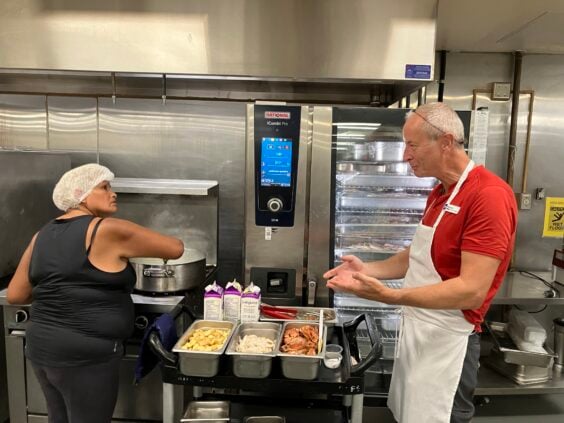
The journey from bedside epiphany to menu integration wasn’t simple. Hospital food systems are notoriously rigid beasts, designed for efficiency and scale rather than cultural nuance. But Michael Saurette, the hospital’s culinary lead, understood that compromise wasn’t an option.
“If you can’t retain the essence of the original, then what are we even doing?” says Saurette, whose enthusiasm for the project had him driving to Fort Langley at dawn to collect fresh bannock from an Indigenous chef. “It’s the same challenge whether you’re Chef Boyardee canning ravioli or preserving a traditional recipe: how much of that original integrity can you retain?”
To best honour Host Nations territories that SPH is situated on, the project started working with Knowledge Keepers from one of the Host Nations, xʷməθkʷəy̓əm (Musqueam), Sḵwx̱wú7mesh (Squamish), and səlilwətaɬ (Tsleil-Waututh). Elsie Guss, a səlilwətaɬ Knowledge Keeper, spent months teaching the hospital team her smoked fish chowder recipe, sharing stories of her childhood by the səl̓ilw̓ət (Burrard Inlet) when fish were plentiful and chowders were traditionally cooked in cedar boxes lined with seaweed.
“More recent studies have shown that the traditional səlilwətaɬ diet was very high in healthy fats and protein through seafood,” explains Jessica Pan, the Indigenous Engagement Specialist driving the project forward. “But in the modern day, the community has no access to their traditional foods due to pollution in the Inlet. Nothing harvested is safe to eat.”
“Elders tell stories of how the waters were so thick with fish you can walk on top of them. And now we’re faced with the sad reality that it’s nearly impossible to source local and Indigenous.” Pan says.
Scaling tradition
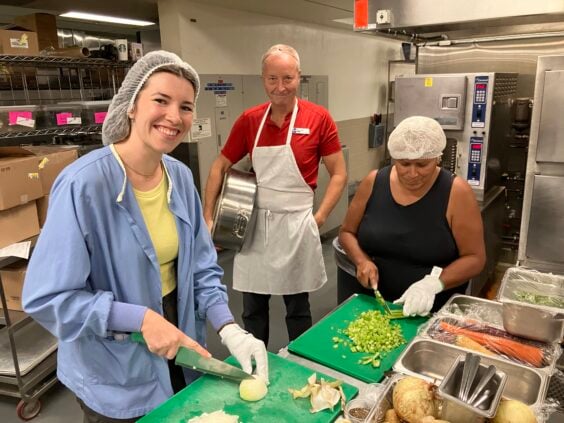
The technical challenges of scaling traditional recipes for hospital production are immense. Take bannock, the Indigenous quick bread developed out of necessity when access to land was limited by colonial power, which became the program’s first success story. Traditional bannock requires small batches, careful hand-shaping, and fresh baking. The hospital’s cook-chill system, designed to prepare food a day in advance and reheat it, turned the beloved bread into something unrecognizable.
“We found that it has a high fat content, and when they would try to batch cook it and freeze off batches, the character would change when it was thawed,” Saurette explains. The (imperfect) solution? SPH Food Services would make one batch weekly that would be served same day hand delivered bedside by the Indigenous Wellness Liaisons (IWLs). While this means that Indigenous patients won’t have access the remaining days of the week, this allows for a quality product that everyone can stand behind.
The IWLs initially raised concerns about the hospital’s early bannock attempts explained Janzen. “They didn’t want to be involved with a product that was not quality.” Rebuilding that trust required a period of intensive weekly taste-testing sessions with Knowledge Keeper Susie Moose and IWL Jaye Currie, tweaking the recipe until it met community standards.
For Jaye Currie, a Pikani Blackfoot and Plains Cree social worker who serves as an Indigenous Wellness Liaison at SPH, the stakes were deeply personal. Bannock isn’t just food—it carries generations of memory and meaning.
“I remember as a child, my Cree grandmother and my Blackfoot grandmother making their bannock and their styles; that was spiritual,” Currie explains. “How bringing together the situation around food and how important that is for our people and sustenance.”
She speaks of bannock as a constant through hard times, a comfort food that sustained her mother, a PhD student and residential school survivor, through lean years as a single mother. “There were times when she was on a shoestring budget and bannock was always there,” Currie says. “It’s comfort food. There’s many aspects to how bannock is a central piece of our identity as Indigenous peoples.”
The challenge of translating that spiritual and cultural significance into hospital production was immense. “Everything was a little bit of this, a little bit of that, right? It wasn’t measurements. It wasn’t so formal,” Currie recalls of working with Susie Moose to train the kitchen staff. “So equating and supporting and liaising between Susie and the kitchen staff, and following their protocols for their kitchen, was challenging but a lot of insight about our cultures and why we did it the way we did it was a lot of teaching on my part about the cultures to the non-indigenous. So, they got it eventually.”
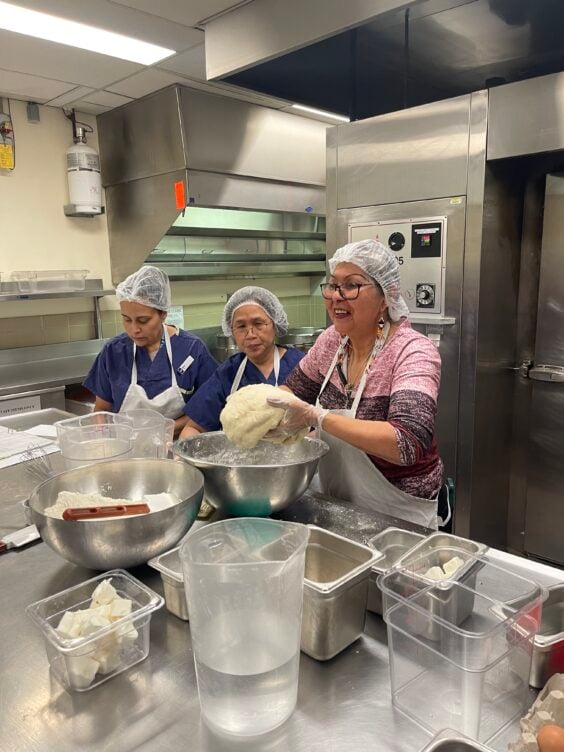
The team would meet weekly—Currie, Moose, Pan, Janzen, and production manager John Santos—examining each batch together, discussing taste and texture, making modifications. When the bannock wasn’t right, they refused to serve it, even if it meant disappointing patients that week.
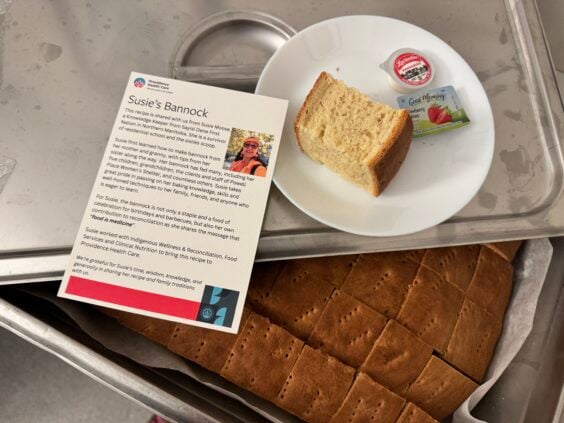
“This is Susie’s name on the bannock, and we want to honour her in that way,” Currie says.
The process revealed another challenge: continuity. Last summer, when trained bakers went on vacation and casual staff stepped in, the quality suffered. “I learned that maybe it’d be a good thing if we could find the funding to train the casual bakers so they could all know,” Currie reflects. It remains a work in progress—the bannock is always influenced by the hands who come together to make it.
Why cultural food improves patient care
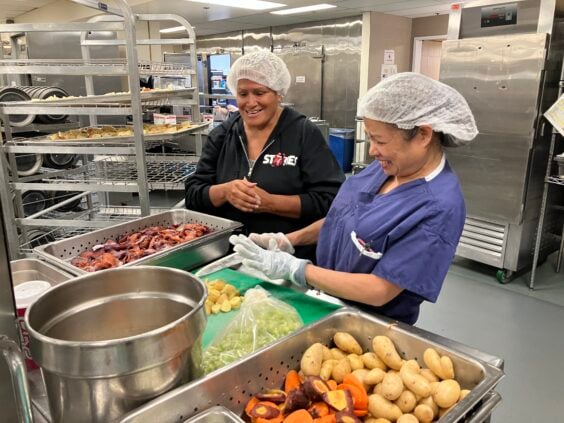
The program’s impact extends far beyond nutrition. In initial community surveys, 88% of Indigenous patients said having culturally familiar foods was important to them. But the benefits run deeper than preference: they touch on healing, identity, connection with the land, and the complex relationship between Indigenous peoples and health care systems.
For Currie, who works primarily with the Road to Recovery (R2R) addictions program—which sees between 40% to 70% Indigenous patients—the food program is part of a larger mission of cultural safety and decolonization within health care.
“I believe that the work that we’re doing here is imperative in regard to the health care system and our Indigenous folks being within the health care system,” she says. “There’s many that suffer from the effects of feeling marginalized and being discriminated against, maybe not in so many words, but through action.”
She references the tragic story of Joyce Echaquan, an Atikamekw woman who died in a Quebec hospital in 2020 after being subjected to racist slurs from nurses in her final hours. “When we bring food forward, that’s a comfort in feeling and it’s food that we Indigenous peoples can identify with,” Currie explains. “That brings them into a space where they can feel culturally safe because they know that someone’s there meeting their needs, that understands them and understands their ways of being and doing as Indigenous people.”
The work goes beyond bannock. Currie facilitates weekly smudging and talking circles for R2R patients on Tuesdays and for the Transitional Care Unit on Wednesdays. “It’s important that we bring those aspects of our culture and safety forward while they’re on their healing journey,” she says. “It’s important to the work we do to let the people know they’re not alone.”
The impact is sometimes surprising. Patients will come back and mention something that touched them, a gesture or offering the staff hadn’t thought twice about. “We never know what really touches their hearts, what really inspires them to keep going and to keep healing on their healing journey,” Currie reflects.
“We’ve had an Asian preference menu for over ten years, and that has not been a question, whereas now we’re talking about the first peoples on unceded territories, yet there hasn’t been the same kind push for ensuring that they are accessing something that would be culturally responsive to their needs,” explains Pan.
For Indigenous patients, foods represent something profound: connection to culture, acknowledgment of identity, and a signal that the health care system sees them as whole people and understandings that food is medicine.
The program also grapples with larger questions about sustainability and cultural appropriation. Hoping to work with Authentic Indigenous Seafoods, a coalition of BC Indigenous fisheries, the team worries about creating demand that could strain traditional harvesting practices and Indigenous communities’ access to their foods.
“You don’t want to mainstream salmonberries and then have them be less special, or totally pillaged,” reflects Saurette. “These cultures had a respect for and balance with nature for thousands of years. You don’t want well-meaning efforts to end up destroying that.”
The future of healing
As other health authorities across BC are also on their own paths of exploring similar initiatives, SPH is developing a model that prioritizes relationship-building over culturally inspired menus. The difference between grabbing a recipe off the internet and working directly with knowledge keepers is substantial—both in authenticity and in the relationships forged.
Currie envisions a future where the program expands across Canada. “I would hope that we would find continuous funding for this. If we’re truly going to reconcile with Indigenous folks, you know, make sure that we connect the dots,” she says. She dreams of having a dedicated segment of the kitchen exclusively for training staff to cook Indigenous food—a permanent infrastructure rather than a perpetual pilot project.
“I would love to have ongoing teaching around the Indigenous food and the spirituality of it. The stories are so important,” Currie emphasizes. She’s already seen the power of education: “The more that I spoke about Indigenous ways of being and doing and the cultural aspect towards food, the more they understood the importance.”
She imagines the same program in hospitals in Winnipeg, Calgary, Montreal, Toronto—anywhere with significant Indigenous patient populations. “It always boils down to money, sadly,” she acknowledges. But the need is clear. When she brings bannock to Indigenous patients at Holy Family Hospital and Youville, where the program hasn’t yet reached formally, “It would be like night and day. They are so grateful for that.”
The program represents something larger than menu diversification. In a country still grappling with the legacy of residential schools and ongoing health care disparities affecting Indigenous peoples, it’s a small but significant act of cultural recognition and respect.
“This is the culture of this land,” Saurette emphasizes. “That should be something that’s valuable to all of us. Something all of us should want to protect.”
“I think a dream would be that this pushes us all to recognize food as medicine,” continues Pan, “and give in-patient food the attention and proper platform it deserves. We are what we eat and proper nutrition is essential to support health and healing.”
As Guss’s chowder makes its third debut on hospital trays on June 21, it carries with it not just traditional flavours, but the hope that health care can become a place where Indigenous patients feel truly seen, valued, and nourished—body and soul.