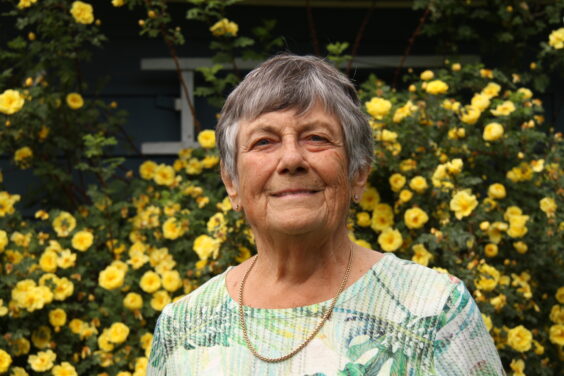
Dixie-Lee Rosher stood on her deck in Summerland one morning. She helped her husband refill plant pots with fresh soil. She lifted pots, moved, and talked as she worked.
That wouldn’t have been possible a few weeks earlier.
“Everything was hard,” Dixie-Lee said. “As a matter of fact, just to give you a thought, just our conversation for the length of time I’ve been chatting with you, I would start getting short of breath.”
Dixie-Lee, 83, has a serious problem with her mitral valve.
What went wrong with her heart
Your heart has valves that control blood flow. They open and close to keep blood moving in the right direction. When a valve leaks, blood flows backward, and your body doesn’t get enough oxygen.
Mitral valve disease is becoming more common as people live longer, and doctors find it earlier. A global study shows cases more than doubled from 7 million in 1990 to 16 million in 2023.
The change touched every part of Dixie-Lee’s life.
“It affected everything,” she said. “And it was progressing very quickly, which was hard. I’m an active or was an active person, and my life was being reduced to sitting in a big chair.”
Simple tasks became hard. She felt tired all the time. Walking was slow, and even thinking felt different.
“They said less than 40 per cent of the blood that my ventricle was pushing out was getting to go around my body,” she said. “That included my brain, so my thinking was sluggish.”
Doctors looked at treatment options. There were no more medications that would help her leaking valve and open chest surgery was too risky.
“My ability to recover from an open chest was becoming less and less,” Dixie-Lee said.
Then her care team at the Heart Centre at St. Paul’s Hospital offered something new.
She became the first patient in Canada to receive the AltaValve, a new heart valve device that is still under study.
How the new valve works
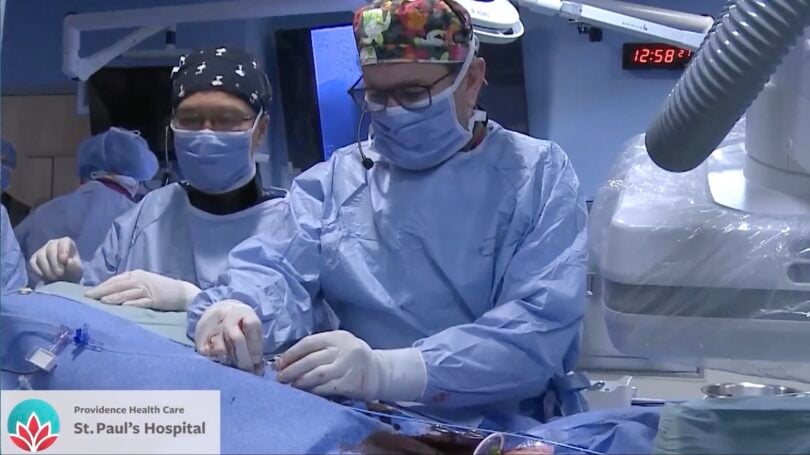
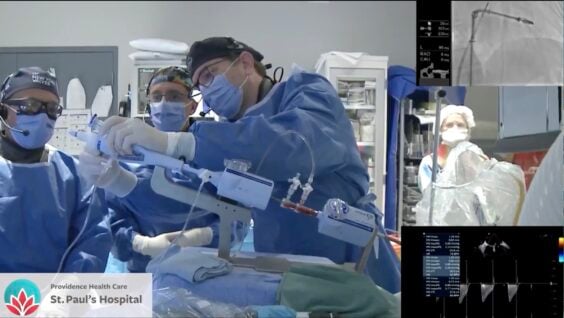
Instead of opening her chest, doctors were able to do a transcatheter procedure, guiding the valve through a tube inserted in her groin. The tube moved through blood vessels to her heart.
Erin Tang, a clinical nurse specialist, helped explain how the AltaValve works.
“It’s available to patients who don’t have the right anatomy for the commercially viable option,” Tang said.
Some current devices use a clip to repair the mitral valve. The clips help the valve close. It works for some people, but it doesn’t work for everyone. Some patients valves are shaped in such a way that the clip will not work.
The AltaValve takes a different approach. It replaces the valve instead of repairing it.
Tang explained it in simple language.
“It’s a valve that’s put onto a tube that gets delivered through the groin with a catheter up into the heart,” she said. “And then once it’s sitting in the correct location above the valve, it gets slowly released, opening up like an umbrella.”
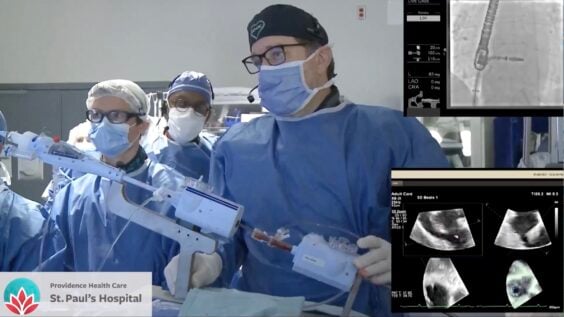
Each device is custom fit for the patient. It sits just inside the damaged valve and takes over its job.
You can think of it like this. One option fixes an old door. The other puts in a new one.
The mitral valve is harder to treat than the aortic valve. Years ago, a procedure called TAVI that was also pioneered at St. Paul’s Hospital (led by Dr. John Webb), changed the care for aortic valve problems worldwide.
AltaValve may help fill a gap for patients with mitral valve problems.
“TAVI has been the focus for many years,” Tang said. “The Alta Valve and other transcather mitral valve replacement devices, are changing the field. It’s been a long time coming, but the future of treating valvular heart disease in older patients is very exciting.”
Careful steps and more results
The procedure for Dixie-Lee took about two and a half hours.
Dixie-Lee’s valve will be monitored carefully in follow-up to ensure she continues to do well.
“We will ensure she does not develop any bleeding problems and that the valve functions well over the long term,” Tang said.
The device is still part of a research study. So far, doctors have used it in 200 cases around the world. They need more long-term results.
Right now, St. Paul’s Hospital is the only site in Canada offering it to a small number of patients who qualify.
“They told us that Dixie-Lee was patient number 200, and we are looking to recruit 400 patients in total,” Tang said.
For Dixie-Lee, the early result was clear.
Life after the procedure
She had the procedure on May 14. Ten days later, she felt the change.
“Everything. Total change,” she said. “I could walk, I could talk, and I could think.”
The procedure changed how she sees her future.
She and her husband have lived in their home since 1972. They raised three children there.
“We’ve made a number of big decisions,” she said. “One of them being that we will be staying in our own home until they take us out feet first.”
Recovery takes time. Her care team gave her a walking plan. Her first walks were hard because her muscles were weak.
The heart can improve first. The rest of the body takes longer to catch up.
Her care continued after she left the hospital. She follows a routine of walking, resting, eating well, and attending check-ins.
Her family played an important role. Her children live across Canada. One son drove her home from Vancouver.
She said clear communication made a difference.
“It’s about the language and understanding what it means,” Dixie-Lee said.
Her nursing background helped her understand the process. But she knows many patients need more support.
“If I hadn’t had the knowledge I had, it would be pretty scary.”
The heart team plans to move forward slowly. Tang said they may do about 10 cases each year. Patients go through careful screening. The goal is to learn from each case, build evidence, and be able to provide a viable option for patients not eligible for conventional treatment.
Tang said the team is also thinking about the future. The procedure may become easier to repeat over time if results continue to improve.
For now, the clearest outcome is in Dixie-Lee’s daily life.
She is back on her deck and is also planning time with family and friends.
“I look at this whole experience as a legacy,” she said. “I have something that I can give back to society.”
She’s also looking ahead to simple plans.
“Our camping trailer is out. We’ll be able to camp, we’ll be able to barbecue, and we’ll be able to entertain more.”
Dixie-Lee has part of her daily life back. That’s how she measures success.
Story by Marcelo Dominguez, Providence Health Care